Caving
The Caving Suite is a set of applications that provide tools for the analysis and interpretation of cave monitoring data sources. Currently, four apps are included in the Caving Suite: Caving Sandbox, Fragmentation, Open Hole Dipping, and Caving Hydraulic Radius.
Caving Sandbox
The Caving Sandbox brings together multiple forms of cave monitoring in order to give users the best possible picture of what is happening in their cave mine.
The app also includes several other charts and tables to help quantify production versus seismicity and the height of the cave back over time. The monitoring methods included in the app are:
- Seismic monitoring
- Smart makers and Networked Smart Markers
- Elexon Cave Tracker beacons
- Open hole dipping
- Extensometers
- Production columns (a projection of the height of draw/cave based on the tonnes drawn from each drawpoint/ring)
- Borehole logging
- Active seismic tomorgraphy
- Fibre optic cable monitoring
- Blasts
- Surface subsidence calculations (automatically calculated displacement between two surface flyovers)

Fragmentation
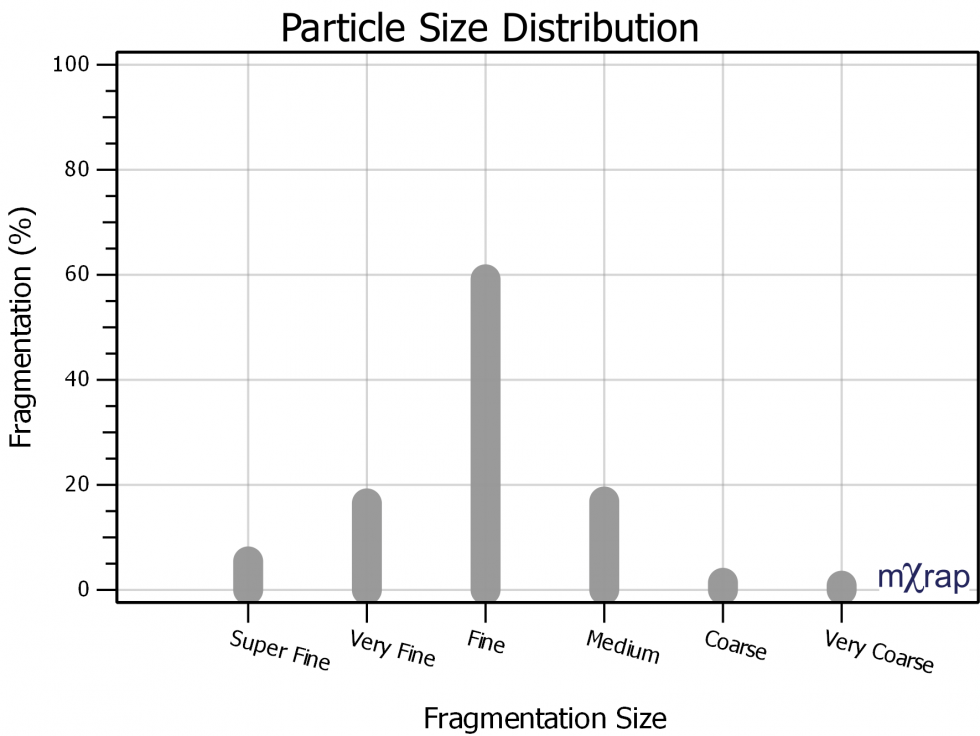
This app analyses and displays caving fragmentation data. The particle size distributions for different drawpoints for different dates can be viewed. Chosen particle size percentile values can be displayed in 3D for different dates and as a column representing the change over time. Pie charts for each drawpoint can be shown in 3D showing the proportion of each size category of the fragmentation. A heatmap of fragmentation can also be plotted in 3D.
Caving hydraulic radius
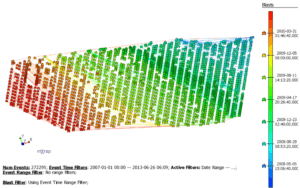
Using the undercut blasting data, this app calculates the hydraulic radius (HR) of the undercut over time. The app provides functions to correlate the seismic response with the hydraulic radius.
Documentation
📄️ Caving Sandbox
Unified cave monitoring platform consolidating multiple data sources.
📄️ Fragmentation
Import, visualise, and analyse fragmentation data with production correlation.
Authors
Principal authors: Liam Niedzielski, Dan Cumming-Potvin
Niedzielski, L & Cumming-Potvin, D 2022, mXrap software, Caving Suite, Australian Centre for Geomechanics, Perth, mxrap.com
Publications
Morkel, IG, Wesseloo, J & Potvin, Y 2022, Seismic event location uncertainty in mining with reference to caving, in Y Potvin (ed.) Caving 2022: Fifth International Conference on Block and Sublevel Caving, Australian Centre for Geomechanics, Perth, pp. 445-460 https://doi.org/10.36487/ACG_repo/2205_30
Woods, MJ, Poulter, ME & King, RG 2018, Progression and management of seismic hazard through the life of Telfer sublevel cave, in Y Potvin & J Jakubec (eds.) Proceedings of the Fourth International Symposium on Block and Sublevel Caving, Australian Centre for Geomechanics, Perth, pp. 623-636 https://doi.org/10.36487/ACG_rep/1815_48_King
Campbell, AD, Ah Mu, E, Bunker, KA & Penney, AR 2016, Managing stress and seismicity in an inclined sublevel cave, Seventh International Conference & Exhibition on Mass Mining (MassMin 2016), The Australasian Institute of Mining and Metallurgy, Melbourne https://www.ausimm.com/publications/conference-proceedings/seventh-international-conference--exhibition-on-mass-mining-massmin-2016/managing-stress-and-seismicity-in-an-inclined-sublevel-cave/